

 中文简体
When someone asks how does activated carbon filter water, they often picture a coarse material straining out dirt like a sieve. The reality is far more interesting. Activated carbon works on a molecular level, attracting and holding contaminants as water flows through. It has been the backbone of taste and odor improvement in drinking water for decades, and it remains a key stage in everything from simple countertop filters to multi-stage reverse osmosis systems.
What Is Activated Carbon Filtration?
Activated carbon begins as a carbon-rich material such as coconut shell, wood or coal. It then goes through an activation process, typically using high-temperature steam, which opens up millions of microscopic pores. The result is an extremely porous structure with a remarkable internal surface area. A single gram of activated carbon can carry the equivalent of several hundred square meters of surface area.
That surface is what does the heavy lifting. As water passes through the carbon, contaminants are drawn to the surface and held there, while cleaner water continues downstream. This mechanism is called adsorption, and it is the foundation of every activated carbon water filter.
For a broader introduction to the overall technology, we have also written a complete guide to activated carbon filtration that covers where it fits into a wider water treatment sequence.
The Mechanism: How Does Activated Carbon Filter Water?
Understanding how activated carbon filters water starts with one key distinction: adsorption versus absorption. Absorption is what a sponge does with water, drawing it into its own volume. Adsorption is different. In adsorption, molecules stick to the outer and inner surfaces of a material without being absorbed into its bulk.
In practice, water enters a cartridge filled with carbon granules or a solid carbon block. The contaminants dissolved in that water, especially chlorine compounds, volatile organic molecules and odor-causing substances, collide with the carbon surface and become trapped by weak chemical attractions. Over time, the carbon builds up more and more of these molecules until its adsorption capacity is exhausted.
The process can be summarized in three stages:
- Water spreads through the pore structure of the carbon media.
- Contaminants bind to the carbon surface through adsorption.
- Treated water exits with fewer chemicals and noticeably improved taste.
A common misconception is that activated carbon works like a strainer, catching particles that are too big to pass. In reality, it removes dissolved contaminants that are far too small for any mechanical sieve to catch.
What Does Activated Carbon Remove?
To be clear about the limits as well as the strengths of activated carbon, here is a summary of its typical reduction performance for common water contaminants.
| Contaminant or parameter | Reduction performance |
|---|---|
| Chlorine and chloramine | Excellent |
| Taste and odor compounds | Excellent |
| Volatile organic compounds | Good to excellent |
| Pesticides and herbicides | Moderate to good |
| Sediment and fine particles | Limited, carbon block only |
| Heavy metals | Limited, unless specially treated |
| Dissolved salts and total dissolved solids | Not removed |
As the table shows, activated carbon is excellent at improving water aesthetics and removing organic chemicals, but it is not a complete treatment solution on its own. That is why it is so often paired with sediment filtration and reverse osmosis in a multi-stage system.
Granular Carbon vs. Carbon Block
Activated carbon filters generally come in two physical forms, and the choice affects performance as well as system design.
Granular activated carbon
Granular activated carbon, often abbreviated as GAC, consists of loose carbon granules inside a cartridge. Water flows around the granules and adsorption takes place at the carbon surface. GAC cartridges allow higher flow rates and are commonly used in whole-house systems and as pre-filters in reverse osmosis setups.
Carbon block
Carbon block, sometimes abbreviated as CTO, is made by compressing finely ground carbon into a solid block. Because the carbon particles are much smaller, the available surface area is more accessible, and the block itself also performs some mechanical filtration. Carbon block cartridges tend to be especially effective at chlorine removal and fine particulate control.
Both forms have a clear place in water treatment. A typical household purifier may use a granular carbon cartridge for initial chlorine reduction and a carbon block for more consistent polishing downstream.
Our 10-inch CTO carbon block cartridge is a compact option for standard filter housings and RO systems.
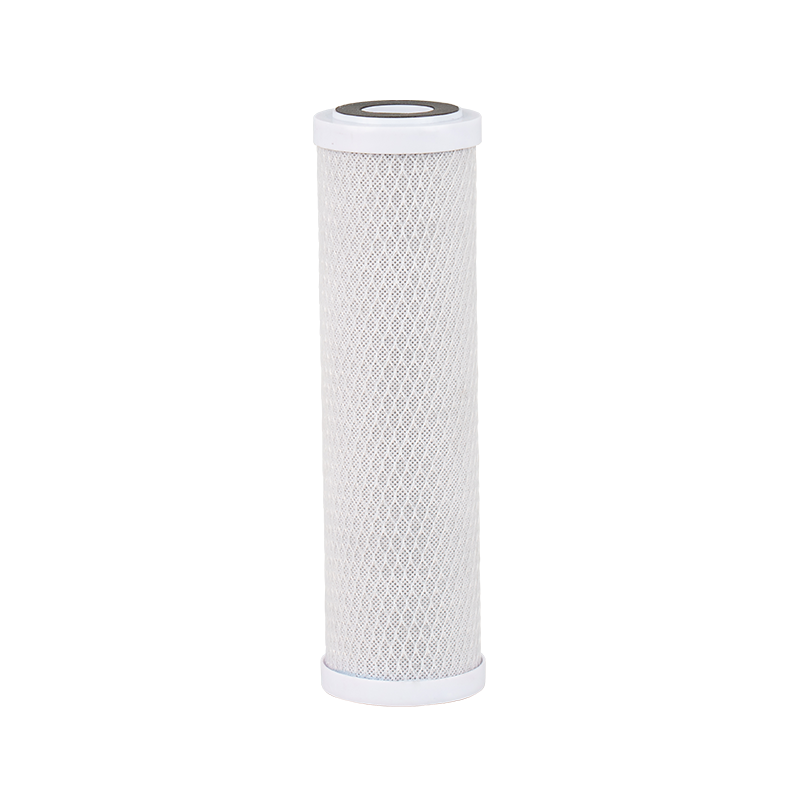 10-Inch CTO Carbon Block Cartridge for Standard HousingsThis compact carbon block filter removes chlorine, odors, and organic compounds, serving as an effective pretreatment stage for RO and household systems.View Product →
For applications that suit loose-fill media, the 10-inch granular activated carbon cartridge offers the same adsorption chemistry in a traditional GAC format.
 10-Inch Granular Activated Carbon Filter CartridgeFor loose-fill applications, this GAC cartridge delivers adsorption performance in a traditional format, enhancing water taste and clarity.View Product →
Activated Carbon in a Multi-Stage Water Purifier
In a reverse osmosis system, activated carbon typically appears in two different positions, and each one has its own job.
The pre-carbon stage sits before the RO membrane. Its main job is to remove chlorine, which would otherwise damage the membrane over time. Removing chlorine early protects the membrane and stabilizes the whole system.
The post-carbon stage sits after the membrane and storage tank. Its job is to polish the finished water, catching any residual taste or odor that may have built up during storage. This final polishing step is where a compact post-carbon cartridge, often called a T33, becomes important.
Our quick-insert post-carbon filter is designed for this final duty in household purifiers.
 Quick Insert Post Carbon Filter for Final PolishingThis final-stage carbon filter removes residual chlorine and trace organics, improving taste and safety with a quick-insert design for household and business systems.View Product →
This staged use of carbon is one reason why modern purifiers combine different filtration mechanisms. Sediment filters handle particles, carbon handles chlorine and organic compounds, and the RO membrane deals with dissolved solids. Each stage protects the next.
How Long Does an Activated Carbon Filter Last?
There is no single replacement interval that fits every system. A few factors matter most:
- Incoming water quality and chlorine level
- Daily water consumption
- Filter capacity and cartridge size
- Number of carbon stages in the system
As a general guideline, a pre-carbon filter in a household RO system is usually replaced every 6 to 12 months. A post-carbon T33 cartridge typically lasts around 12 months. If the chlorine taste or odor returns noticeably, that is a reliable sign that the carbon has reached its capacity and should be changed.
Once activated carbon is exhausted, it does not simply become less effective; it stops adsorbing altogether. In some cases, an exhausted carbon bed can even become a place for bacterial growth. Regular replacement is therefore a health consideration, not just a maintenance recommendation.
Final Thoughts
So how does activated carbon filter water? Through adsorption: its enormous internal surface attracts and holds chlorine, organic compounds and taste-causing molecules while clean water moves on. It is the most widely used technology for improving the taste and smell of drinking water, and a natural companion to reverse osmosis in multi-stage purification.
Knowing how activated carbon works makes it easier to choose the right cartridge, plan replacements and get the most from any purification system. If you have questions about carbon cartridges or want to discuss filter specifications for your own products, feel free to contact us.